Gênesis 19

ARC · Chapter 19/50

1E vieram os dois anjos a Sodoma á tarde, e estava Lot assentado á porta de Sodoma; e vendo-os Lot, levantou-se ao seu encontro, e inclinou-se com o rosto á terra;

2E disse: Eis agora, meus senhores, entrae, peço-vos, em casa de vosso servo, e passae n'ella a noite, e lavae os vossos pés; e de madrugada vos levantareis, e ireis vosso caminho. E elles disseram: Não, antes na rua passaremos a noite.

3E porfiou com elles muito, e vieram com elle, e entraram em sua casa: e fez-lhes banquete, e cozeu bolos sem levadura, e comeram.

4E antes que se deitassem, cercaram a casa, os varões d'aquella cidade, os varões de Sodoma, desde o moço até ao velho; todo o povo de todos os bairros.

5E chamaram a Lot, e disseram-lhe: Onde estão os varões que a ti vieram n'esta noite? Tral-os fóra a nós, para que os conheçamos.

6Então saiu Lot a elles á porta, e fechou a porta atraz de si,

7E disse: Meus irmãos, rogo-vos que não façaes mal:

8Eis aqui, duas filhas tenho, que ainda não conheceram varão; fora vol-as trarei, e fareis d'ellas como bom fôr nos vossos olhos; sómente nada façaes a estes varões, porque por isso vieram á sombra do meu telhado.

9Elles porém disseram: Sae d'ali. Disseram mais: Como estrangeiro este individuo veiu aqui habitar, e quereria ser juiz em tudo? Agora te faremos mais mal a ti do que a elles. E arremessaram-se sobre o varão, sobre Lot, e approximaram-se para arrombar a porta.

10Aquelles varões porém estenderam a sua mão, e fizeram entrar a Lot comsigo na casa, e fecharam a porta;

11E feriram de cegueira os varões que estavam á porta da casa, desde o menor até ao maior, de maneira que se cançaram para achar a porta.

12Então disseram aquelles varões a Lot: Tens alguem mais aqui? teu genro, e teus filhos, e tuas filhas, e todos quantos tens n'esta cidade, tira-os fóra d'este logar;

13Porque nós vamos destruir este logar, porque o seu clamor tem engrossado diante da face do Senhor, e o Senhor nos enviou a destruil-o.

14Então saiu Lot, e fallou a seus genros, aos que haviam de tomar as suas filhas, e disse: Levantae-vos, sahi d'este logar; porque o Senhor ha de destruir a cidade. Foi tido porém por zombador aos olhos de seus genros.

15E ao amanhecer os anjos apertaram com Lot, dizendo: Levanta-te, toma tua mulher, e tuas duas filhas que aqui estão, para que não pereças na injustiça d'esta cidade.

16Elle porém demorava-se, e aquelles varões lhe pegaram pela mão, e pela mão de sua mulher, e pela mão de suas duas filhas, sendo-lhe o Senhor misericordioso, e tiraram-o, e puzeram-o fóra da cidade.

17E aconteceu que, tirando-os fóra, disse: Escapa-te por tua vida; não olhes para traz de ti, e não pares em toda esta campina; escapa lá para o monte, para que não pereças.

18E Lot disse-lhe: Ora não, Senhor!

19Eis que agora o teu servo tem achado graça aos teus olhos, e engrandeceste a tua misericordia que a mim me fizeste, para guardar a minha alma em vida: e eu não posso escapar no monte, para que porventura não me apanhe este mal, e eu morra.

20Eis que agora esta cidade está perto, para fugir para lá, e é pequena: ora para ali me escaparei (não é pequena?), para que minha alma viva

21E disse-lhe: Eis aqui, tenho-te acceitado tambem n'este negocio, para não derribar esta cidade, de que fallaste:

22Apressa-te, escapa-te para ali; porque nada poderei fazer, emquanto não tiveres ali chegado. Por isso se chamou o nome da cidade Zoar.

23Saiu o sol sobre a terra, quando Lot entrou em Zoar.

24Então o Senhor fez chover enxofre e fogo, do Senhor desde os céus, sobre Sodoma e Gomorrah;

25E derribou aquellas cidades, e toda aquella campina, e todos os moradores d'aquellas cidades, e o que nascia da terra.

26E a mulher de Lot olhou para traz d'elle, e ficou convertida n'uma estatua de sal.

27E Abrahão levantou-se aquella mesma manhã, de madrugada, e foi para aquelle logar onde estivera diante da face do Senhor;

28E olhou para Sodoma e Gomorrah, e para toda a terra da campina; e viu, e eis que o fumo da terra subia, como o fumo d'uma fornalha.

29E aconteceu que, destruindo Deus as cidades da campina, Deus se lembrou de Abrahão, e tirou a Lot do meio da destruição, derribando aquellas cidades em que Lot habitara.

30E subiu Lot de Zoar, e habitou no monte, e as suas duas filhas com elle; porque temia de habitar em Zoar; e habitou n'uma caverna, elle e as suas duas filhas.

31Então a primogenita disse á menor: Nosso pae é já velho, e não ha varão na terra que entre a nós, segundo o costume de toda a terra;

32Vem, demos de beber vinho a nosso pae, e deitemo-nos com elle, para que em vida conservemos semente de nosso pae.

33E deram de beber vinho a seu pae n'aquella noite; e veiu a primogenita, e deitou-se com seu pae, e não sentiu elle quando ella se deitou, nem quando se levantou.

34E succedeu, no outro dia, que a primogenita disse á menor: Vês aqui, eu já hontem á noite me deitei com meu pae: demos-lhe de beber vinho tambem esta noite, e então entra tu, deita-te com elle, para que em vida conservemos semente de nosso pae.

35E deram de beber vinho a seu pae, tambem n'aquella noite; e levantou-se a menor, e deitou-se com elle; e não sentiu elle quando ella se deitou, nem quando se levantou.

36E conceberam as duas filhas de Lot de seu pae.

37E pariu a primogenita um filho, e chamou o seu nome Moab; este é o pae dos moabitas, até ao dia d'hoje.

38E a menor tambem pariu um filho, e chamou o seu nome Benammi; este é o pae dos filhos de Ammon, até o dia d'hoje.
📖 Chapter study

Summary

Two angels visit Lot in Sodom; the city is destroyed by fire and brimstone because of its wickedness, Lot's wife turns into a pillar of salt after looking back, and his daughters later have children by him through deception.

Explanation

This chapter shows the fulfillment of the judgment announced in the previous chapter: the extreme wickedness of Sodom (portrayed in the violent attempt of the city's men against Lot's visitors) leads to the complete destruction of the region. Lot, despite his earlier questionable choices (Genesis 13), is rescued by God's mercy, showing that salvation often comes in spite of our failures, not because of our merit. Lot's wife, by disobeying the order not to look back, becomes a symbol of attachment to what must be left behind — recalled by Jesus in Luke 17:32 ('remember Lot's wife'). The disturbing ending of the chapter, with Lot's daughters getting him drunk in order to have children, shows how the corrupted environment of Sodom had deeply affected even the values of his own family, without the text approving or glorifying the act.

Fun facts

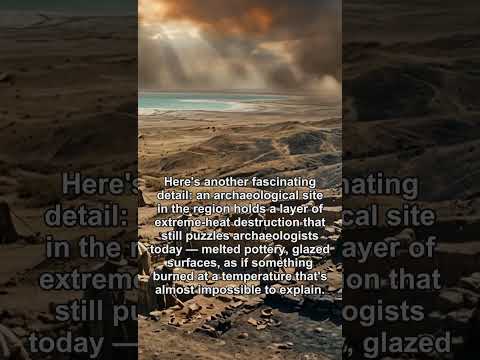
  • The region where Sodom and Gomorrah stood is generally associated by archaeologists with the area south of the Dead Sea, a region rich in deposits of sulfur and bitumen, which may explain elements of the description of 'fire and brimstone' in the destruction.
  • Moab and Ammon, nations mentioned repeatedly throughout the rest of the Old Testament, originate, according to this chapter, from the sons born to Lot's daughters — showing how this painful episode connects to future conflicts and relations between Israel and its neighboring peoples.

Verse-by-verse explanation

  1. Gênesis 19:1The “two angels” who arrive at Sodom are two of the three visitors who had appeared to Abraham in the previous chapter—the third, understood to be the LORD Himself, had stayed behind talking with Abraham about the city’s fate. Here they arrive disguised as ordinary travelers, and that’s how Lot receives them.
  2. Gênesis 19:2Lot invites the two disguised angels to spend the night safely at his house instead of sleeping in the street—the same generous hospitality Abraham had shown in the previous chapter.
  3. Gênesis 19:3Lot insists so much that the visitors agree to come in, and he prepares a quick meal with unleavened bread—a simple dish, made in a hurry, showing the urgency of his hospitality.
  4. Gênesis 19:4Even before they lie down to sleep, men from all over the city surround Lot’s house—“both old and young” shows this wasn’t an isolated group, it was the whole city gathered.
  5. Gênesis 19:5Asking to “know” the visitors is a biblical euphemism for sexual relations—the men of the city want to sexually assault the two strangers Lot had welcomed into his home. It’s this group attack, driven by hostility toward outsiders, that confirms the city’s wickedness already mentioned back in chapter 13.
  6. Gênesis 19:6Lot goes out to try to stop the violence, shutting the door behind him—an attempt to protect the visitors by facing the crowd alone, without exposing them.
  7. Gênesis 19:7Lot calls the crowd “brethren” in an attempt to calm the situation, asking them not to harm the visitors staying in his house.
  8. Gênesis 19:8Lot goes so far as to offer his own daughters to the crowd to protect the visitors—a gesture that shocks any reader today, but that reflects how seriously hospitality toward a guest was taken in the culture of the time: protecting whoever was under your roof was seen as an almost sacred duty, even above the safety of one’s own family. The text doesn’t praise Lot’s choice, it simply records it.
  9. Gênesis 19:9The crowd turns its hostility against Lot himself, calling him a foreigner with no authority to judge anyone—and moves to break down the door, making clear that the violence won’t stop with words.
  10. Gênesis 19:10It’s the visitors themselves, not Lot, who resolve the situation: they pull Lot inside and shut the door, showing they had power to act beyond anything any human there could manage.
  11. Gênesis 19:11The visitors strike the crowd outside with blindness, keeping them from finding the door—the first concrete proof, for Lot, that these were no ordinary travelers.
  12. Gênesis 19:12The angels ask Lot if he has any more relatives in the city, because their intention is to get everyone who belongs to his family out before the destruction.
  13. Gênesis 19:13The angels openly reveal to Lot the reason for their visit: they were sent to destroy the city, because of how great the outcry against its wickedness had become.
  14. Gênesis 19:14Lot warns his sons-in-law about the coming destruction, but they don’t believe him and think he’s joking—no one in Lot’s extended family takes the warning seriously.
  15. Gênesis 19:15At daybreak, the angels press Lot to leave at once with his wife and two daughters, warning that he too will be destroyed if he keeps hesitating inside the city.
  16. Gênesis 19:16Even after the warning, Lot is slow to act, and it’s the angels themselves who take the family by the hand and pull them out of the city by force—the text credits this to God’s mercy, not to any initiative on Lot’s part.
  17. Gênesis 19:17Outside, the angels give a clear instruction: flee without looking back and without stopping in the plain, seeking refuge in the mountains.
  18. Gênesis 19:18Lot responds by asking not to have to follow that instruction exactly, opening the way for the alternative request he makes in the verses that follow.
  19. Gênesis 19:19Lot acknowledges the mercy he has already received, but argues he won’t be able to reach the mountains in time to escape the danger.
  20. Gênesis 19:20Lot asks to flee to a small, nearby town instead of the distant mountains—a request for an exception to the original instruction.
  21. Gênesis 19:21The angel accepts Lot’s request and agrees to spare that small town as well, granting what he asked.
  22. Gênesis 19:22The angel hurries Lot to move quickly, explaining that the destruction can only begin once he’s safe—and the text explains that this is why the city receives the name Zoar, tied to the word for “little.”
  23. Gênesis 19:23Marks the exact moment: the sun had already risen when Lot finally enters Zoar, safe.
  24. Gênesis 19:24Describes the destruction of Sodom and Gomorrah with brimstone and fire from the sky—an image of total, sudden judgment upon the cities.
  25. Gênesis 19:25The destruction reaches not only the cities but the whole surrounding region, including the vegetation—nothing in the area was left standing after this judgment.
  26. Gênesis 19:26Lot’s wife looks back, disobeying the order not to look, and turns into a “pillar of salt”—likely a popular, ancient explanation for salt-rock formations that really do exist in the Dead Sea region. The point of the story is the disobedience to the order to flee without looking back, more than the physical mechanism of the transformation.
  27. Gênesis 19:27Abraham returns to the very place where he had negotiated with God in the previous chapter, looking out the next morning to see what had happened to Sodom.
  28. Gênesis 19:28Abraham sees smoke rising from the region like from a furnace—visual confirmation, from a distance, that the destruction really happened.
  29. Gênesis 19:29The text clarifies that Lot was spared because of Abraham, not on his own merit—God remembers the relationship between the two of them when it comes time to pull Lot out of the destruction.
  30. Gênesis 19:30Afraid to stay in Zoar, Lot ends up going to the mountains anyway, living in a cave with his two daughters—the very fate he had tried to avoid earlier.
  31. Gênesis 19:31Lot’s daughters, isolated in the mountains, believe there’s no man left in the world to father children with them—a fear that leads to the plan told through the rest of the chapter.
  32. Gênesis 19:32Lot’s daughters get pregnant by their own father after getting him drunk, believing there were no more men available to father children after Sodom’s destruction. It’s one of the harshest episodes in the book of Genesis, and the text neither approves nor explicitly condemns it—it simply narrates what happened and why, without moral comment.
  33. Gênesis 19:33On the first night, the older daughter carries out the plan: she gets her father drunk and lies with him without his realizing anything, either at the time or afterward.
  34. Gênesis 19:34The next day, the older daughter proposes repeating the plan with her younger sister, keeping the same justification of preserving their father’s line.
  35. Gênesis 19:35The second night repeats the first: the father is made drunk, and the younger daughter lies with him without his realizing it.
  36. Gênesis 19:36Confirms the outcome of the two sisters’ plan: both become pregnant by their own father.
  37. Gênesis 19:37The names given to the two sisters’ sons, Moab and Ben-ammi, sound in Hebrew like “from father” and “son of my people”—a way of explaining, through the names themselves, the origin of the Moabite and Ammonite peoples, who will later appear as Israel’s neighbors further on in the Bible. It’s an origin legend told through wordplay on names, a common device in this kind of ancient narrative.
  38. Gênesis 19:38The younger daughter also has a son, Ben-ammi, who gives rise to the Ammonite people—together with the Moabite people mentioned in the previous verse, these two nations neighboring Israel are born from this episode.

Watch the story of this passage

Videos from our channel that tell what happens in Genesis 19.

Chapters

Our apps

Our apps →

Bible in Stories

The Bible told as a story, with audio and videos.

📱 Get the app

World in Stories

True stories of humanity that sound made up.

Feito! Pequenas Vitórias

A light daily routine for people who lose track of the day.