Ester 4

ARC · Chapter 4/10

1Quando Mardoqueo soube tudo quanto havia passado, rasgou Mardoqueo os seus vestidos, e vestiu-se de um sacco com cinza, e saiu pelo meio da cidade, e clamou com grande e amargo clamor;

2E chegou até diante da porta do rei: porque ninguem vestido de sacco podia entrar pelas portas do rei.

3E em todas as provincias aonde a palavra do rei e a sua lei chegava, havia entre os judeos grande luto, com jejum, e choro, e lamentação: e muitos estavam deitados em sacco e em cinza.

4Então vieram as moças de Esther, e os seus eunuchos, e fizeram-lh'o saber, do que a rainha muito se doeu: e mandou vestidos para vestir a Mardoqueo, e tirar-lhe o seu sacco; porém elle os não acceitou.

5Então Esther chamou a Hathach (um dos eunuchos do rei, que este tinha posto na presença d'ella), e deu-lhe mandado para Mardoqueo; para saber que era aquillo; e para que.

6E, saindo Hathach a Mardoqueo, á praça da cidade, que estava diante da porta do rei,

7Mardoqueo lhe fez saber tudo quanto lhe tinha succedido; como tambem a offerta da prata, que Haman dissera que daria para os thesouros do rei, pelos judeos, para os lançar a perder.

8Tambem lhe deu a copia da lei escripta, que se publicara em Susan, para os destruir, para a mostrar a Esther, e a fazer saber: e para lhe ordenar que, se fosse ter com o rei, e lhe pedisse e supplicasse na sua presença pelo seu povo.

9Veiu pois Hathach, e fez saber a Esther as palavras de Mardoqueo.

10Então disse Esther a Hathach, e mandou-lhe dizer a Mardoqueo:

11Todos os servos do rei, e o povo das provincias do rei, bem sabem que todo o homem ou mulher que entrar no pateo interior ao rei sem ser chamado não ha senão uma sentença, que morra, salvo se o rei estender para elle o sceptro d'oiro, para que viva; e eu estes trinta dias não sou chamada para entrar ao rei

12E fizeram saber a Mardoqueo as palavras d'Esther.

13Então disse Mardoqueo que tornassem a dizer a Esther: Não imagines em teu animo que escaparás na casa do rei, mais do que todos os outros judeos.

14Porque, se de todo te calares n'este tempo, soccorro e livramento d'outra parte sairá para os judeos, mas tu e a casa de teu pae perecereis: e quem sabe se para tal tempo como este chegaste a este reino?

15Então disse Esther que tornassem a dizer a Mardoqueo:

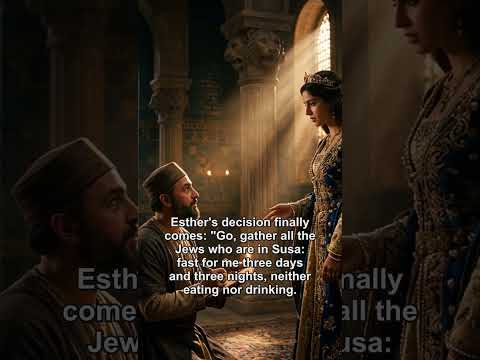
16Vae, ajunta a todos os judeos que se acharem em Susan, e jejuae por mim, e não comaes nem bebaes por tres dias, nem de dia nem de noite, e eu e as minhas moças tambem assim jejuaremos: e assim entrarei a ter com o rei, ainda que não é segundo a lei; e, perecendo, pereça.

17Então Mardoqueo foi, e fez conforme a tudo quanto Esther lhe ordenou.

📖 Chapter study

Summary

Mordecai, in deep mourning, asks Esther to intervene with the king to save her people. Esther fears for her own life, since appearing before the king unsummoned could mean death, but Mordecai convinces her with a line that has become famous.

Explanation

This is the emotional turning point of the book. Esther faces a real dilemma: reveal her Jewish identity and risk her life, or remain silent and safe while her people are exterminated. Mordecai responds with one of the most striking lines in the Bible: 'who knows whether you have not come to the kingdom for such a time as this?'—suggesting that positions of privilege or influence may serve a greater purpose than personal comfort. Esther decides to act, but first asks everyone to fast for her, showing that even though the book never mentions God, the people still turn to spiritual practices of dependence on him in the face of danger.

Fun facts

  • Esther's line 'if I perish, I perish,' spoken as she decides to risk her life, echoes the same spirit of total submission found in other biblical figures facing extreme decisions of faith.
  • The three-day fast Esther requests, with no specific mention of prayer, is the closest the book comes to an explicit religious practice, suggesting a spirituality that is present but understated throughout the narrative.

Verse-by-verse explanation

  1. Ester 4:1Mordecai reacts to the decree with the traditional signs of deep mourning: torn clothes, sackcloth, ashes, and a loud, bitter cry that he makes a point of expressing publicly through the streets.
  2. Ester 4:2Even with normal access to the palace, Mordecai is barred from entering because he is dressed in mourning, a rule of court etiquette that leaves him standing outside.
  3. Ester 4:3Mordecai’s reaction repeats on a far larger scale: Jews throughout the empire fall into collective mourning as soon as news of the decree of extermination reaches them.
  4. Ester 4:4Esther only learns something is wrong through her own attendants, and her first reaction is to try to solve the problem practically, sending ordinary clothes to Mordecai, still without knowing the real reason for his mourning.
  5. Ester 4:5Esther turns to a trusted eunuch, Hatach, to act as go-between and find out exactly what was happening with Mordecai.
  6. Ester 4:6Hatach goes in person to the city square where Mordecai was, serving as a bridge between him and the queen inside the palace.
  7. Ester 4:7Mordecai tells Hatach the whole story, including the specific detail of the silver Haman had offered to fund the extermination.
  8. Ester 4:8Mordecai even sends a physical copy of the decree as proof, along with a direct request that Esther personally intervene with the king on behalf of her own people.
  9. Ester 4:9Hatach returns and faithfully passes on Mordecai’s entire message to Esther.
  10. Ester 4:10Esther replies through the same intermediary, beginning an indirect dialogue between the two that will determine the course of the whole story.
  11. Ester 4:11There was a strict law in the Persian court: whoever entered the king’s inner court without being called could be put to death, unless the king held out the golden sceptre as a sign of pardon. This law is the concrete obstacle Esther must face in order to speak to the king about Haman’s plan.
  12. Ester 4:12Esther’s message, explaining the deadly risk of appearing before the king unsummoned, is carried back to Mordecai.
  13. Ester 4:13Mordecai answers firmly, warning Esther that being queen would not automatically protect her from the decree of extermination, even while hiding her Jewish origin.
  14. Ester 4:14Mordecai tells Esther that if she stays silent, deliverance for the Jews will arise “from another place,” and suggests that perhaps she came to her royal position for exactly a moment like this. It is one of the few instances in the book that hints at a greater force working behind the scenes without naming it: in fact, throughout the entire book of Esther, the word God never appears once, something rare among the books of the Bible.
  15. Ester 4:15Esther replies once more through the same channel, preparing the most important request of the whole exchange.
  16. Ester 4:16Esther decides to risk her own life by going in unsummoned, but first asks that all the Jews of Shushan fast for three days along with her and her maidens. Her closing line, “if I perish, I perish,” sums up the wager she is making.
  17. Ester 4:17For the first time in the story, it is Mordecai who obeys an instruction from Esther, not the other way around, a sign that the roles between the two were shifting in the face of the crisis.

Watch the story of this passage

Videos from our channel that tell what happens in Esther 4.

Chapters

Our apps

Our apps →

Bible in Stories

The Bible told as a story, with audio and videos.

📱 Get the app

World in Stories

True stories of humanity that sound made up.

Feito! Pequenas Vitórias

A light daily routine for people who lose track of the day.