Pentateuch · Genesis · Genesis 12–22
The Journey of Abraham
Leaving Without Knowing Where
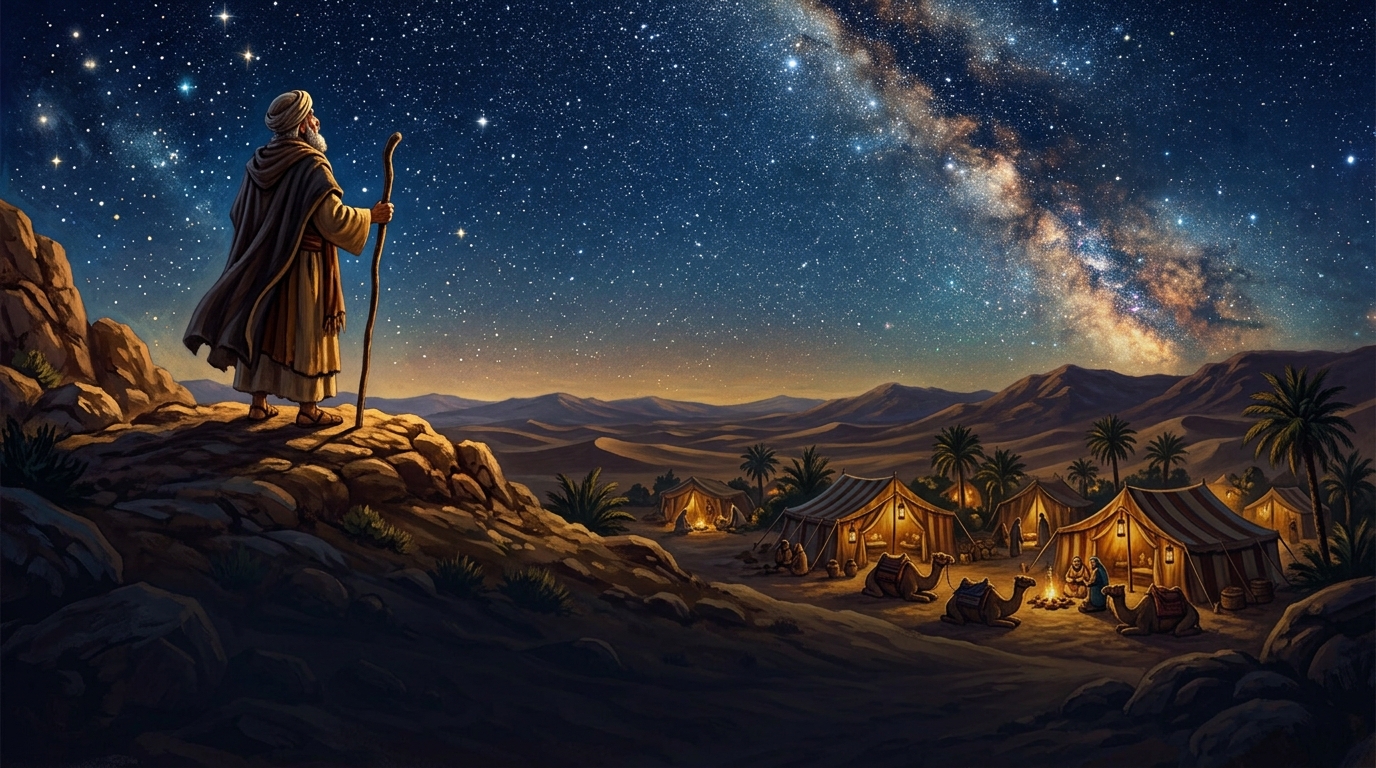
Abram was seventy-five years old, with a life built in Haran and no natural reason to leave it behind. Yet God's voice was clear: leave your country, your kindred, and your father's house, and go to a place that did not even have a name yet. The promise was immense — a great nation, a new name, a blessing that would reach every people on earth. Abram did not ask where he was going. He simply went.
The journey was not a straight line. Famine struck almost as soon as he arrived, a lie was told in Egypt, Lot had to be separated from him, and a war was fought to rescue his captured nephew. And there was waiting — years of waiting for a son the promise guaranteed, though Sarah, already old and barren, seemed unable to bear one. One night, God brought Abram outside his tent and pointed to the sky: count the stars, if he could count them — so would his descendants be. And Abram believed the LORD.
After a human attempt to hurry the promise along — the birth of Ishmael, Hagar's son — God confirmed the covenant with a sign in the flesh and a new name: no longer Abram, but Abraham, father of many nations. And against all logic, in their old age, he and Sarah held the promised son in their arms: Isaac, whose name carries laughter — the laughter of Sarah's disbelief, later turned into laughter of joy.
The final test came like a blow: take his beloved son and offer him as a burnt offering on a mountain God would show him. Abraham obeyed once more, climbing Mount Moriah with the wood, the fire, and a breaking heart. At the last instant, his hand was stayed, and a ram caught by its horns took Isaac's place. Abraham named that place 'the LORD will provide,' and the covenant was sealed once and for all: in his offspring, all the nations of the earth would be blessed.
“Now the Lord had said unto Abram, Get thee out of thy country, and from thy kindred, and from thy father’s house, unto a land that I will shew thee:”
Key verse · Genesis 12:1
💡 Did you know?
- Ur of the Chaldees, Abraham's hometown, was not some lost desert village: archaeological excavations have revealed a well-developed Sumerian metropolis, complete with a great ziggurat dedicated to the moon god Sin. Abraham left comfort and urban civilization behind to follow a promise.
- Mount Moriah, where Abraham nearly offered Isaac, is identified in Scripture itself as the same mountain where, centuries later, Solomon built the temple in Jerusalem (2 Chronicles 3:1) — the place forever marked, from then on, as the one where 'the LORD will provide.'
✝️ Connection to Christ
On Mount Moriah, Isaac carried on his own shoulders the wood for the sacrifice that would be offered in his place — just as, centuries later, Jesus would carry the cross on which He would be offered for us. The ram that took Isaac's place points to the Lamb who would take the place of all humanity (John 8:56; Hebrews 11:17-19).
➜ Practical application
Abraham obeyed before he could see the whole map, and believed a promise he would never see fully fulfilled in his lifetime. Biblical faith is not having all the answers — it is taking the first step even without seeing the whole road ahead. What 'land' is God asking you to leave behind today, even without knowing exactly where you will end up?
To reflect
What haven't you let go of yet because you're afraid to move forward without guarantees?
🗺️ Where it happened
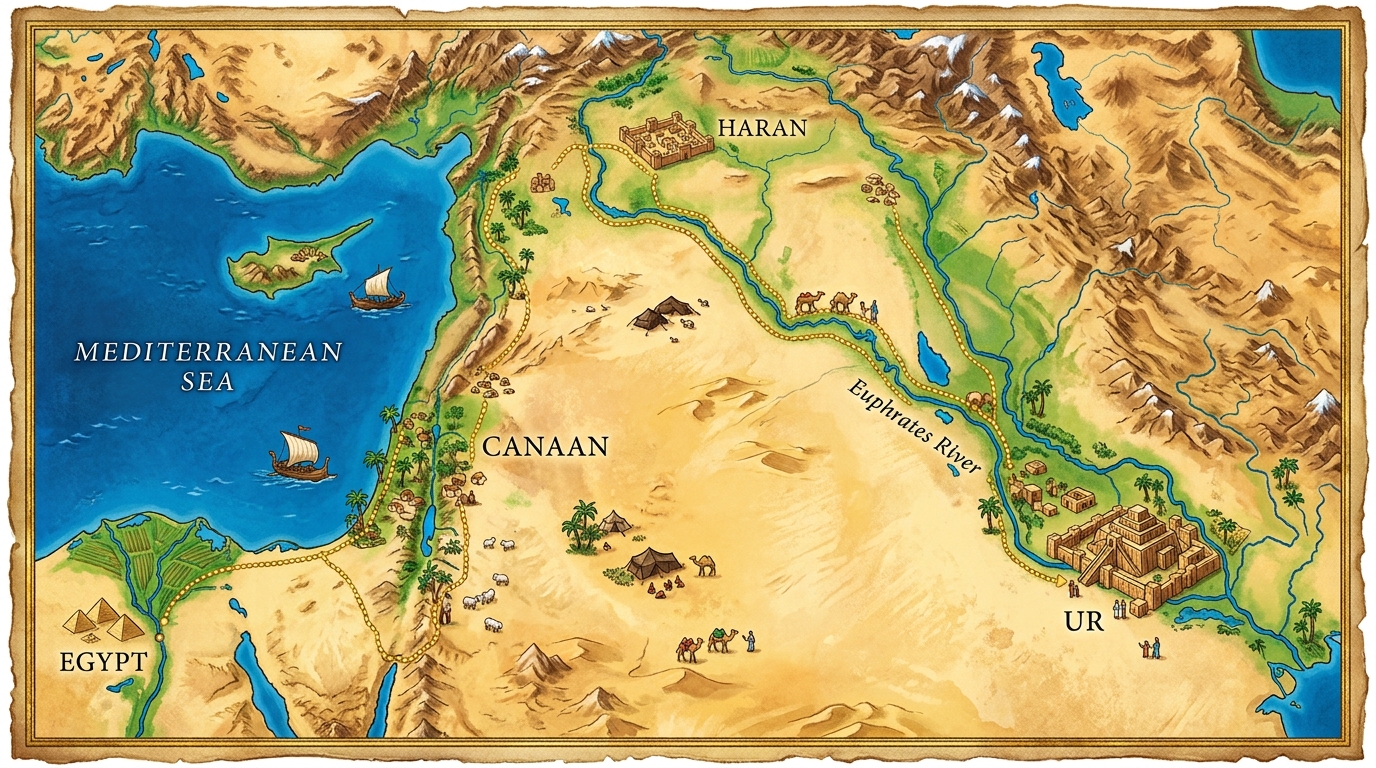
From Ur of the Chaldees to Canaan, Abraham's journey crossed the Fertile Crescent toward the promised land.
Region
From Ur to Canaan
Period
~2000 BC
Characters
Abraham, Sarah, Isaac, Lot
Central theme
Faith and covenant
📜 Bible timeline
- Creation and the Fall
- The Flood · Noah
- Tower of Babel
- ⭐ The Patriarchs — you are here
- Out of Egypt — ~1446 BC
- The Promised Land — ~1406 BC
- United Kingdom — ~1050 BC
- The Prophets — ~760 BC
- Babylon — ~586 BC
- Jesus Christ — ~4 BC
- New Creation
“And Abraham called the name of that place Jehovah–jireh: as it is said to this day, In the mount of the Lord it shall be seen.”
Genesis 22:14
📱 Also in the Bíblia em Histórias app